Frameworks and regulations
All major ESG frameworks and regulations, operationalized in one system
Turn ESG frameworks and regulations into workflows your team can run in one system.
Frameworks and regulations
All major ESG frameworks and regulations, operationalized in one system
Turn ESG frameworks and regulations into workflows your team can run in one system.















































Built on global best practices
Due diligence principles built into every workflow
Worldfavor is built on globally recognized frameworks and a risk-based approach, enabling companies to structure due diligence and ESG data processes with consistency.
The challenge
Regulations are clear. Running eight of them at once is not.
Companies must navigate overlapping frameworks with similar requirements. Turning them into consistent, actionable workflows is where complexity arises.
Regulations and frameworks overlap across ESG topics.
The same data is requested in different formats
Difficult to prioritize what matters most
Hard to maintain consistency across processes
The challenge
Regulations are clear. Running eight of them at once is not.
Companies must navigate overlapping frameworks with similar requirements. Turning them into consistent, actionable workflows is where complexity arises.
Regulations and frameworks overlap across ESG topics.
The same data is requested in different formats
Difficult to prioritize what matters most
Hard to maintain consistency across processes
The challenge
Regulations are clear. Running eight of them at once is not.
Companies must navigate overlapping frameworks with similar requirements. Turning them into consistent, actionable workflows is where complexity arises.
Regulations and frameworks overlap across ESG topics.
The same data is requested in different formats
Difficult to prioritize what matters most
Hard to maintain consistency across processes
Our approach
From regulation to actionable execution
One system for every framework you report against, every cycle. Your team spends its time on action, not on keeping regulations aligned.
Requirement alignment
Bring the regulations and frameworks that matter to your business into one system
Requirement alignment
Bring the regulations and frameworks that matter to your business into one system
Requirement alignment
Bring the regulations and frameworks that matter to your business into one system
Structured data model
Structure ESG data once and use it across frameworks and reporting needs
Structured data model
Structure ESG data once and use it across frameworks and reporting needs
Structured data model
Structure ESG data once and use it across frameworks and reporting needs
Workflow logic
Turn requirements into actionable workflows
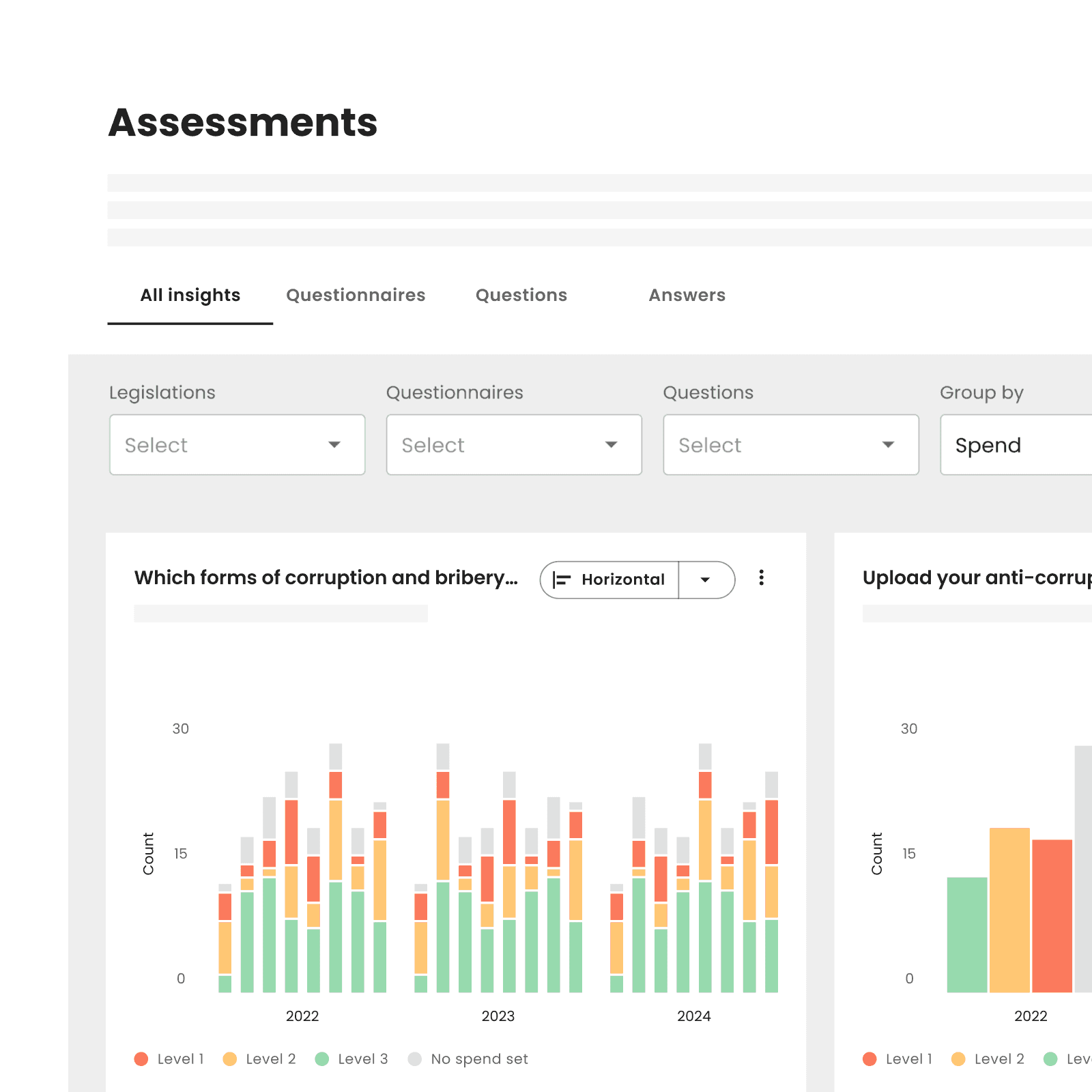
Workflow logic
Turn requirements into actionable workflows
Workflow logic
Turn requirements into actionable workflows
Continuous updates
Stay aligned with evolving regulations and frameworks with updates from experts

Continuous updates
Stay aligned with evolving regulations and frameworks with updates from experts
Continuous updates
Stay aligned with evolving regulations and frameworks with updates from experts
Built on globally recognized frameworks and continuously updated by sustainability experts
Built on globally recognized frameworks and continuously updated by sustainability experts
How it works
Turn frameworks and regulations into actionable workflows
Start by identifying risks to define your scope, then leverage expert-built workflows and ready-to-use content to structure ESG processes from data collection to reporting in one unified system.
Screen and identify
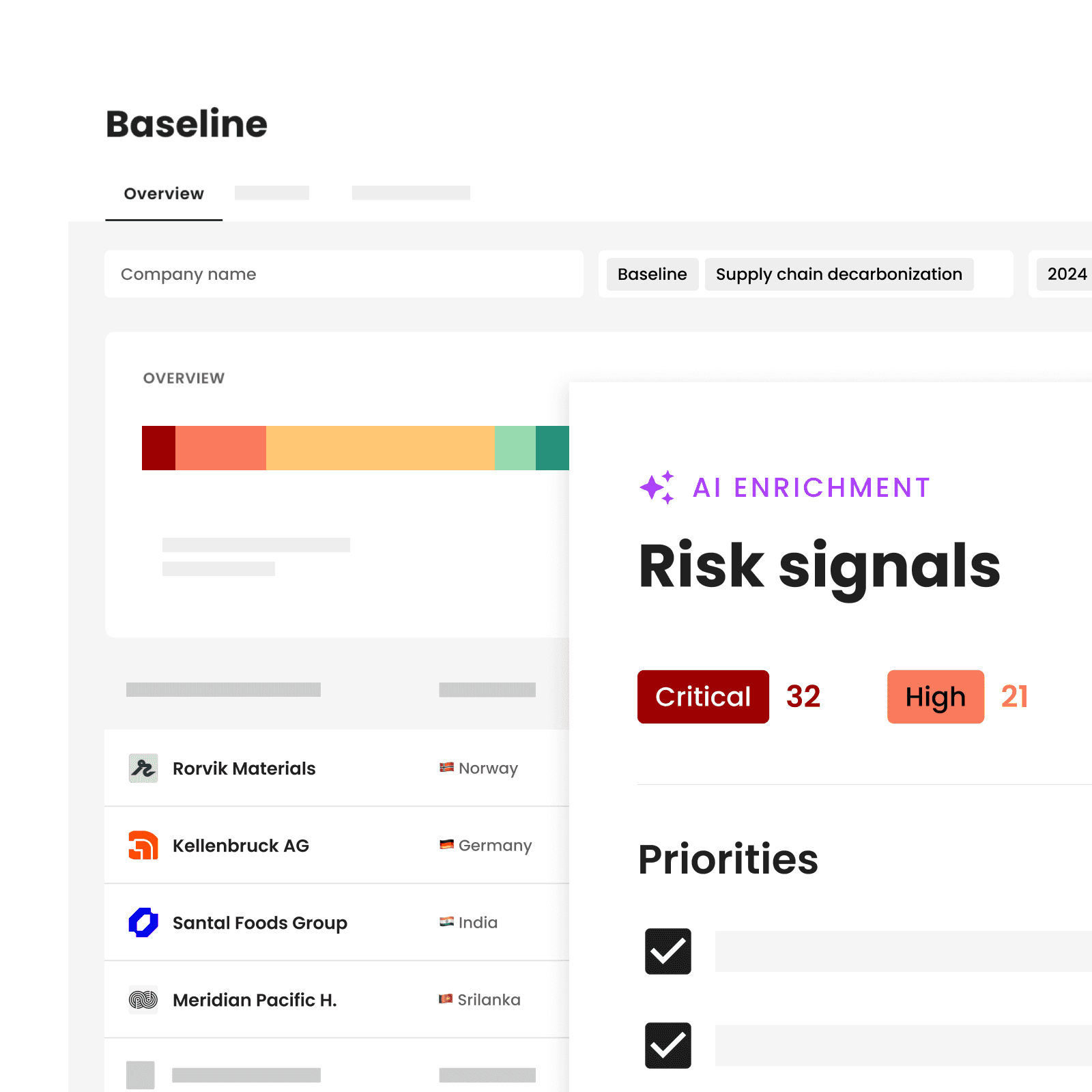
Use AI to identify risks and prioritize where to focus first
Organize your scope
Map suppliers, entities or portfolios based on identified priorities
Collect and assess
Collect the right data once in a centralized model aligned across frameworks
Act and improve
Take action, set expectations and track progress in an auditable trail
Report and disclose
Use one source of truth to generate reports aligned with multiple requirements
Reduce effort at every step with centralized data and cross-framework workflows for you and your suppliers
Reduce effort at every step with centralized data and cross-framework workflows for you and your suppliers


Regulations
Pre-built compliance workflows, ready to run
Regulations and frameworks are built into the system, so you can focus on execution instead of managing alignment
Åpenhetsloven (Transparency Act)
Manage human rights due diligence, decent working conditions, and transparency
Screen suppliers to identify risks before engagement
Prioritize human rights and working condition risks
Collect structured Social sustainability data
Provide transparent, ready-to-share Åpenhetsloven statements and templates
CSDDD
Manage risk-based due diligence across your value chain
Screen suppliers before engagement
Collect the right due diligence data
Prioritize risks by severity
Maintain a traceable due diligence record
EU Forced Labour Regulation ( EUFLR )
Manage forced labour due diligence ahead of the 2027 ban
Screen suppliers and countries for forced labor risk
Prioritize by severity, likelihood and product
Collect supplier evidence with a pre-built assessment
Report results inside your existing sustainability repo
PPWR
Assess packaging suppliers against PPWR requirements
Identify which economic operator roles apply
Send one assessment to packaging suppliers
Confirm a process, plan and documentation exist
Share supplier readiness data on PPWR
CSRD
Structure ESG reporting aligned with ESRS requirements
Define scope based on double materiality
Collect the right ESG data
Ensure traceability across reporting
Generate audit-ready reports
EUDR
Ensure traceability and deforestation-free sourcing
Engage your suppliers on EUDR requirements
Prioritize deforestation and non-compliance risks
Collect EUDR compliance data
Provide a repository for EUDR disclosures
LkSG
Manage supply chain risk and corrective actions
Conduct ongoing risk analyses
Identify risks across operations and direct suppliers
Define expectations and track corrective actions
Maintain traceable and audit-proof documentation
SFDR
Manage SFDR reporting for direct investments
Engage & collect investee ESG data for PAI reporting
Use pre-made SFDR templates aligned with EDCI and InvestEurope best practices
Support investee development with digital tools
Generate ready-to-share PAI report
Åpenhetsloven (Transparency Act)
Manage human rights due diligence, decent working conditions, and transparency
Screen suppliers to identify risks before engagement
Prioritize human rights and working condition risks
Collect structured Social sustainability data
Provide transparent, ready-to-share Åpenhetsloven statements and templates
CSRD
Structure ESG reporting aligned with ESRS requirements
Define scope based on double materiality
Collect the right ESG data
Ensure traceability across reporting
Generate audit-ready reports
CSDDD
Manage risk-based due diligence across your value chain
Screen suppliers before engagement
Collect the right due diligence data
Prioritize risks by severity
Maintain a traceable due diligence record
EUDR
Ensure traceability and deforestation-free sourcing
Engage your suppliers on EUDR requirements
Prioritize deforestation and non-compliance risks
Collect EUDR compliance data
Provide a repository for EUDR disclosures
EU Forced Labour Regulation ( EUFLR )
Manage forced labour due diligence ahead of the 2027 ban
Screen suppliers and countries for forced labor risk
Prioritize by severity, likelihood and product
Collect supplier evidence with a pre-built assessment
Report results inside your existing sustainability repo
LkSG
Manage supply chain risk and corrective actions
Conduct ongoing risk analyses
Identify risks across operations and direct suppliers
Define expectations and track corrective actions
Maintain traceable and audit-proof documentation
PPWR
Assess packaging suppliers against PPWR requirements
Identify which economic operator roles apply
Send one assessment to packaging suppliers
Confirm a process, plan and documentation exist
Share supplier readiness data on PPWR
SFDR
Manage SFDR reporting for direct investments
Engage & collect investee ESG data for PAI reporting
Use pre-made SFDR templates aligned with EDCI and InvestEurope best practices
Support investee development with digital tools
Generate ready-to-share PAI report
Annual reporting and due diligence cycles, structured to repeat and improve over time
Annual reporting and due diligence cycles, structured to repeat and improve over time
Frameworks
Integrated ESG frameworks
Frameworks are integrated directly into the system, so you don’t need to manage them separately and can focus your effort on execution rather than alignment.
OECD DUE DILIGENCE GUIDELINES
Run due diligence on the framework CSDDD is drawn from.
The OECD Due Diligence Guidelines set the six step sequence that CSDDD, LkSG and Åpenhetsloven all draw on. Worldfavor's workflows follow that sequence, so one process serves every regulation that asks for it.
GHG Protocol
Calculate emissions on the GHG Protocol's scopes and areas.
The GHG Protocol splits emissions into scope 1, 2 and 3, and Worldfavor's calculator uses those scopes and emission areas with factors from libraries such as DEFRA. Scope 3 runs through your supply chain, where supplier data becomes your input.
UN Global Compact (UNGC)
Commit to ten principles on human rights and labor.
Global framework covering human rights, labor, environment and anti-corruption principles.
TCFD
Report climate risk in financial terms.
Disclosure framework covering how climate risk affects governance, strategy, risk management and financial planning.
EDCI
Report portfolio ESG data on a shared industry template.
Private equity initiative standardizing ESG metrics across portfolio companies.
EU TAXONOMY
See which of your activities count as taxonomy aligned.
The EU Taxonomy classifies economic activities against technical screening criteria. Companies in scope of CSRD report the share of turnover, capex and opex that qualifies, which needs activity level data rather than a company average.
SCIENCE BASED TARGETS INITIATIVE
Set emissions targets your suppliers can actually report against.
The Science Based Targets initiative validates corporate emissions targets against climate science. Meeting a scope 3 target depends on supplier data, which is where most programs stall.
Human Rights Due Diligence
Identify and act on human rights risk, every cycle.
Approach to identify, prevent and address human rights impacts across operations and suppliers.
CDP
Answer the climate questionnaire your customers send.
Disclosure framework for climate, water and forest impact, reported annually.
BSCI
Improve working conditions across your supplier base.
amfori BSCI code of conduct and audit framework for labor conditions in supply chains.
ISO 20400
Build sustainable procurement into how you buy, not alongside it.
ISO 20400 is guidance for embedding sustainability into procurement policy, strategy and supplier processes. It is guidance rather than a certifiable standard, so the work shows in your processes rather than in a certificate.
GRI
Cover the GRI topics that reach into your supply chain.
GRI Standards ask companies to report on the topics material to their business, including labor conditions and supplier practices. Those disclosures draw on data held outside your own operations, so the reporting depends on what your suppliers disclose.
UN Guiding Principles (UNGP)
Respect human rights across your operations and suppliers.
Framework defining corporate responsibility to respect human rights across operations and supply chains.
SASB / ISSB
Disclose what investors in your sector consider material.
Standards for industry-specific sustainability disclosures linked to financial materiality.
OECD DUE DILIGENCE GUIDELINES
Run due diligence on the framework CSDDD is drawn from.
The OECD Due Diligence Guidelines set the six step sequence that CSDDD, LkSG and Åpenhetsloven all draw on. Worldfavor's workflows follow that sequence, so one process serves every regulation that asks for it.
ISO 20400
Build sustainable procurement into how you buy, not alongside it.
ISO 20400 is guidance for embedding sustainability into procurement policy, strategy and supplier processes. It is guidance rather than a certifiable standard, so the work shows in your processes rather than in a certificate.
SCIENCE BASED TARGETS INITIATIVE
Set emissions targets your suppliers can actually report against.
The Science Based Targets initiative validates corporate emissions targets against climate science. Meeting a scope 3 target depends on supplier data, which is where most programs stall.
UN Global Compact (UNGC)
Commit to ten principles on human rights and labor.
Global framework covering human rights, labor, environment and anti-corruption principles.
UN Guiding Principles (UNGP)
Respect human rights across your operations and suppliers.
Framework defining corporate responsibility to respect human rights across operations and supply chains.
CDP
Answer the climate questionnaire your customers send.
Disclosure framework for climate, water and forest impact, reported annually.
EDCI
Report portfolio ESG data on a shared industry template.
Private equity initiative standardizing ESG metrics across portfolio companies.
EU TAXONOMY
See which of your activities count as taxonomy aligned.
The EU Taxonomy classifies economic activities against technical screening criteria. Companies in scope of CSRD report the share of turnover, capex and opex that qualifies, which needs activity level data rather than a company average.
GHG Protocol
Calculate emissions on the GHG Protocol's scopes and areas.
The GHG Protocol splits emissions into scope 1, 2 and 3, and Worldfavor's calculator uses those scopes and emission areas with factors from libraries such as DEFRA. Scope 3 runs through your supply chain, where supplier data becomes your input.
GRI
Cover the GRI topics that reach into your supply chain.
GRI Standards ask companies to report on the topics material to their business, including labor conditions and supplier practices. Those disclosures draw on data held outside your own operations, so the reporting depends on what your suppliers disclose.
Human Rights Due Diligence
Identify and act on human rights risk, every cycle.
Approach to identify, prevent and address human rights impacts across operations and suppliers.
TCFD
Report climate risk in financial terms.
Disclosure framework covering how climate risk affects governance, strategy, risk management and financial planning.
SASB / ISSB
Disclose what investors in your sector consider material.
Standards for industry-specific sustainability disclosures linked to financial materiality.
BSCI
Improve working conditions across your supplier base.
amfori BSCI code of conduct and audit framework for labor conditions in supply chains.
OECD DUE DILIGENCE GUIDELINES
Run due diligence on the framework CSDDD is drawn from.
The OECD Due Diligence Guidelines set the six step sequence that CSDDD, LkSG and Åpenhetsloven all draw on. Worldfavor's workflows follow that sequence, so one process serves every regulation that asks for it.
EU TAXONOMY
See which of your activities count as taxonomy aligned.
The EU Taxonomy classifies economic activities against technical screening criteria. Companies in scope of CSRD report the share of turnover, capex and opex that qualifies, which needs activity level data rather than a company average.
ISO 20400
Build sustainable procurement into how you buy, not alongside it.
ISO 20400 is guidance for embedding sustainability into procurement policy, strategy and supplier processes. It is guidance rather than a certifiable standard, so the work shows in your processes rather than in a certificate.
GHG Protocol
Calculate emissions on the GHG Protocol's scopes and areas.
The GHG Protocol splits emissions into scope 1, 2 and 3, and Worldfavor's calculator uses those scopes and emission areas with factors from libraries such as DEFRA. Scope 3 runs through your supply chain, where supplier data becomes your input.
SCIENCE BASED TARGETS INITIATIVE
Set emissions targets your suppliers can actually report against.
The Science Based Targets initiative validates corporate emissions targets against climate science. Meeting a scope 3 target depends on supplier data, which is where most programs stall.
GRI
Cover the GRI topics that reach into your supply chain.
GRI Standards ask companies to report on the topics material to their business, including labor conditions and supplier practices. Those disclosures draw on data held outside your own operations, so the reporting depends on what your suppliers disclose.
UN Global Compact (UNGC)
Commit to ten principles on human rights and labor.
Global framework covering human rights, labor, environment and anti-corruption principles.
Human Rights Due Diligence
Identify and act on human rights risk, every cycle.
Approach to identify, prevent and address human rights impacts across operations and suppliers.
UN Guiding Principles (UNGP)
Respect human rights across your operations and suppliers.
Framework defining corporate responsibility to respect human rights across operations and supply chains.
TCFD
Report climate risk in financial terms.
Disclosure framework covering how climate risk affects governance, strategy, risk management and financial planning.
CDP
Answer the climate questionnaire your customers send.
Disclosure framework for climate, water and forest impact, reported annually.
SASB / ISSB
Disclose what investors in your sector consider material.
Standards for industry-specific sustainability disclosures linked to financial materiality.
EDCI
Report portfolio ESG data on a shared industry template.
Private equity initiative standardizing ESG metrics across portfolio companies.
BSCI
Improve working conditions across your supplier base.
amfori BSCI code of conduct and audit framework for labor conditions in supply chains.
Continuously reviewed and updated by sustainability experts
Continuously reviewed and updated by sustainability experts

Methodology
Built in line with OECD Due Diligence Guidelines
Your due diligence follows the OECD six step framework. Our in-house sustainability team maintains the methodology and updates it each cycle.
Identify and prioritize risks across your value chain
Implement and track preventive and corrective actions
Maintain continuous and traceable due diligence processes
Report how impacts are addressed, cycle after cycle
Methodology
Built in line with OECD Due Diligence Guidelines
Your due diligence follows the OECD six step framework. Our in-house sustainability team maintains the methodology and updates it each cycle.
Identify and prioritize risks across your value chain
Implement and track preventive and corrective actions
Maintain continuous and traceable due diligence processes
Report how impacts are addressed, cycle after cycle
Methodology
Built in line with OECD Due Diligence Guidelines
Your due diligence follows the OECD six step framework. Our in-house sustainability team maintains the methodology and updates it each cycle.
Identify and prioritize risks across your value chain
Implement and track preventive and corrective actions
Maintain continuous and traceable due diligence processes
Report how impacts are addressed, cycle after cycle
Alignment holds only if someone maintains the mapping.
Alignment holds only if someone maintains the mapping.
Frequently asked questions
Frequently asked questions
Which regulations and frameworks does Worldfavor cover, and how are they kept current?
My company falls under multiple regulations. Do I collect data separately for each?
How does Worldfavor turn regulation requirements into workflows my team can actually run?
Where do I start if I don't know which frameworks apply to my business yet?
How does AI help identify and prioritize risks across my supplier base?

See your suppliers screened. Live. In 30 minutes.
Most due diligence cycles start with the biggest suppliers. Yours can start with the riskiest.
Bring your own list and see which those are.
See your suppliers screened.
Live. In 30 minutes.
Most due diligence cycles start with the biggest suppliers.
Yours can start with the riskiest.
Bring your own list and see which those are.
See your suppliers screened. Live.
In 30 minutes.
Most due diligence cycles start with the biggest suppliers. Yours can start with the riskiest.
Industries



Industries